- Have any questions?
- +91 99908 16780
- info@ai-cbse.com

Computational Thinking and Artificial Intelligence: The Foundation Every AI Student Needs
Model Test Paper 2 XII AI 2025-26
March 18, 2026PART A – UNIT 1: Communication Skills
May 27, 2026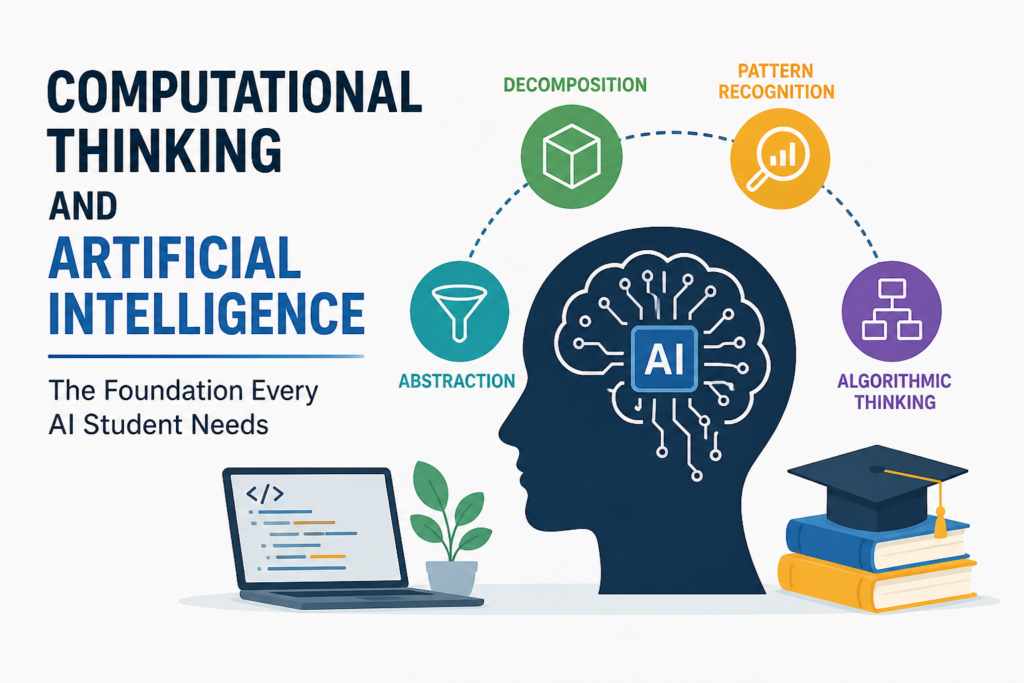
Computational Thinking & AI
Artificial Intelligence (AI) is no longer a futuristic idea. It’s already part of daily life, from voice assistants to recommendation systems. But behind every AI system is a way of thinking that makes it all possible: computational thinking.
If you’re learning AI, understanding computational thinking will give you a real advantage. It helps you approach problems clearly and build smarter solutions.
Let’s break it down in a simple and practical way.
What Is Computational Thinking?
Computational thinking is a method of solving problems step by step. It helps you take complex problems and make them easier to handle.
It’s not just for coding. It’s a thinking skill that applies to math, science, and real-world situations.
The Four Key Skills of Computational Thinking
1. Abstraction: Focus on What Matters
Abstraction is the skill of simplifying a problem by removing unnecessary details and keeping only what’s important.
At first, this sounds easy, but it’s one of the hardest skills to master. In real problems, there’s always extra information that can distract you. Good abstraction means knowing what to ignore.
How it works
When you use abstraction, you:
- Identify the core problem
- Remove irrelevant data
- Represent the problem in a simpler form
For example, if you’re building a weather prediction model, you don’t need every single detail about a city. You focus on key factors like temperature, humidity, and pressure.
In Artificial Intelligence
AI systems deal with massive amounts of data. Without abstraction, models would become slow and inefficient.
Abstraction helps AI:
- Focus on useful features (like edges in images or keywords in text)
- Reduce noise in data
- Improve accuracy and speed
Simple Example
Think of a map. A map doesn’t show every tree or building. It only shows what you need, like roads and landmarks. That’s abstraction.
2. Pattern Recognition: Spotting Trends
Pattern recognition is about identifying similarities, repetitions, or trends in data.
It’s how humans learn, and it’s also how AI systems learn.
How it works
When you use pattern recognition, you:
- Look for repeated structures
- Compare similar cases
- Predict what might come next
For example:
- Recognizing that a sequence increases by 2 each time
- Noticing that certain types of emails are always spam
In Artificial Intelligence
Pattern recognition is the core of machine learning.
AI models are trained on data to find patterns such as:
- Faces in images
- Fraud in transactions
- User preferences in apps
The better the system is at spotting patterns, the better its predictions.
Simple Example
Streaming platforms suggest movies based on what you’ve watched before. They recognize patterns in your choices and compare them with others.
3. Decomposition: Breaking Problems Down
Decomposition means dividing a complex problem into smaller, manageable parts.
Instead of trying to solve everything at once, you handle one piece at a time.
How it works
When you use decomposition, you:
- Identify different parts of a problem
- Solve each part separately
- Combine the solutions
This approach reduces confusion and makes large problems easier to handle.
In Artificial Intelligence
AI systems are rarely built in one step. They are made up of multiple components.
For example, a voice assistant includes:
- Speech recognition
- Language understanding
- Response generation
Each part is developed separately and then combined.
Simple Example
Think of organizing an event:
- Booking a venue
- Sending invitations
- Arranging food
Each task is separate, but together they complete the event.
4. Algorithmic Thinking: Creating Step-by-Step Solutions
Algorithmic thinking is the ability to design clear, logical steps to solve a problem.
An algorithm is simply a set of instructions.
How it works
When you use algorithmic thinking, you:
- Define a sequence of steps
- Use rules and conditions
- Ensure the solution is repeatable
For example:
- Start
- Check condition
- Take action
- Repeat or stop
In Artificial Intelligence
Algorithms are the backbone of AI.
They tell the system:
- How to process data
- How to make decisions
- How to improve over time
Without algorithms, AI systems cannot function.
Simple Example
A recipe is an algorithm:
- Add ingredients
- Follow steps in order
- Get a consistent result
Similarly, AI follows instructions to produce results.
Why Students Should Learn Computational Thinking for AI
If you’re serious about AI, computational thinking is a must.
It helps you:
- Think logically and clearly
- Write better code
- Understand complex systems
- Solve real-world problems
Even advanced AI concepts become easier when your fundamentals are strong.
Closure
Artificial Intelligence may seem complex, but it’s built on simple ideas. Computational thinking gives you a clear way to approach problems and design solutions.
If you develop these skills early, learning AI becomes much more manageable and practical.