- Have any questions?
- +91 99908 16780
- info@ai-cbse.com

Mastering Pattern Recognition: The Ultimate Guide to Computational Thinking & AI
PART A – UNIT 2: Self Management Skills
May 30, 2026
Pattern Recognition in Machine Learning
September 20, 2026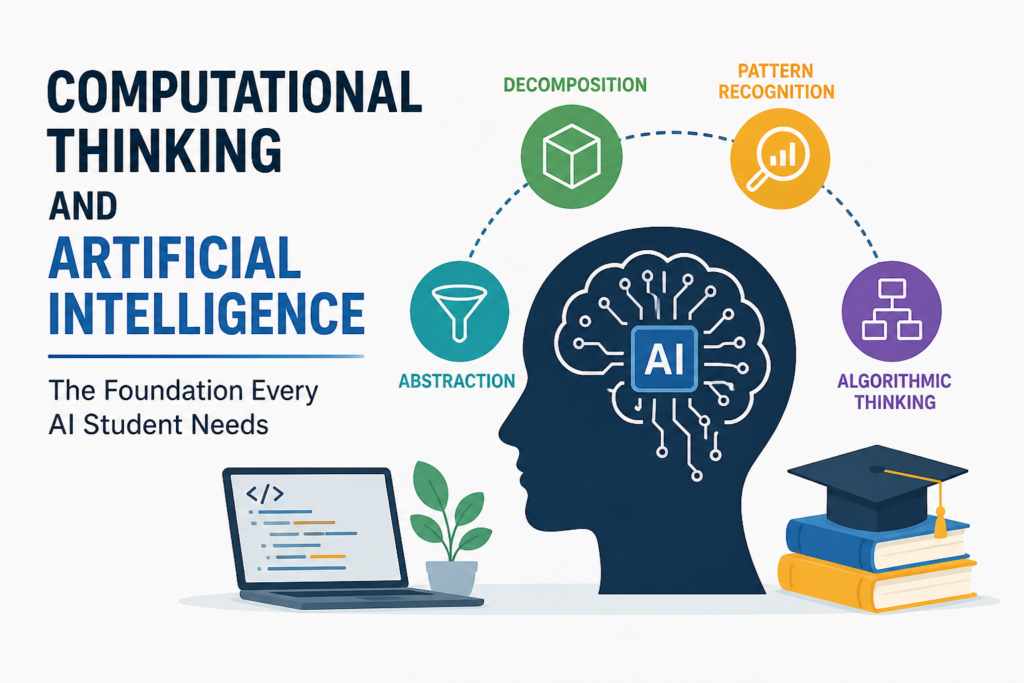
Computational Thinking & Pattern Recognition
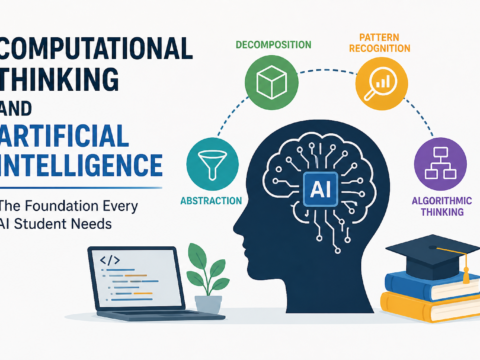
Welcome to the world of Pattern Recognition! Whether you are a student ready to become a “data detective” or a teacher guiding the next generation of tech leaders, understanding patterns is your superpower. In Class 6, pattern recognition is more than just finding the next number; it is a core pillar of Computational Thinking (CT) and the very foundation of how Artificial Intelligence (AI) works.
While earlier grades focused on simple patterns, Class 6 introduces a major “step up”: you will now learn to identify, extend, and justify patterns that involve multiple rules happening at the same time.
——————————————————————————–
The Five Domains of Pattern Mastery
The sources identify five specific areas where patterns hide:
1. Mixed Operation Number Patterns
Instead of just adding the same number every time, these sequences use two or more operations.
- The Example: 2,5,11,23,47,….
- The Secret Rule: To get the next number, you multiply by 2 and then add 1 (×2+1).
- AI Connection: This helps computers with forecasting, like predicting future weather or stock prices.
2. Multi-Attribute Shape Shifters
In these patterns, shapes change in several ways at once, such as their size, position, count, or orientation.
- The Strategy: Use Attribute Decomposition5. Don’t guess the whole rule at once; create a table and track each change (like color or rotation) separately before combining them.
- Example: A small triangle pointing up becomes a medium triangle pointing right, then a large triangle pointing down. Two rules are happening: the size increases AND it rotates 90° clockwise.
3. Alphabet Ciphers & Positional Logic
Letters follow rules based on their position in the alphabet (A=1,B=2…) or the “gaps” between them.
- The Example: A,C,F,J,O,….
- The Secret Rule: The gap between letters increases by one each time (skip 1, then 2, then 3, then 4).
- AI Connection: This is the basis of encryption, which is how computers keep your passwords and messages secret.
4. Cycles and Grouping
Some patterns repeat in loops (cycles) or grow in specific clusters.
- The Remainder Method: If you have a cycle of 4 shapes and need to find the 47th term, divide 47 by 410. The remainder (which is 3) tells you that the 47th term is the same as the 3rd term in the cycle.
- Grouping Example: (1),(2,3),(4,5,6)… In this pattern, each new group contains one more number than the group before it.
5. The Dependency Matrix
This is the “Boss Level”12. You are given a grid where the rows follow one rule and the columns follow another. To find a missing value, you must decode both rules simultaneously. This is exactly how neural networks in AI process complex data.
——————————————————————————–
Pro-Tips for Success (Students & Teachers)
- The RPV Strategy: Before writing an answer, follow three steps: Rule (state it in words), Prediction (guess the next terms), and Verify (check if they fit).
- The “Rule of Four”: Never guess a rule based on only two terms15. You need at least three terms to form a hypothesis and four terms to be confident.
- Justification Matters: Getting the “right” answer is less important than being able to justify and explain the rule clearly.
——————————————————————————–
Practice Zone: 10 Challenges for Students:
Q1: The Number Detective (LO 1)
Identify the rule and find the next term in this sequence: 3,7,15,31,63,… Rule: ____________________ Next Term: ___________
Q2: Shape Story Strips (LO 2)
Study the sequence below. Draw the missing 4th shape based on the rules.
| Term 1 | Term 2 | Term 3 | Term 4 |
|---|---|---|---|
| ? | |||
| (Small, Red) | (Medium, Blue) | (Large, Red) | (Draw Here) |
Hint: Use Attribute Decomposition to track Size and Color.
Q3: Alphabet Cipher (LO 3)
Using the logic A=1,B=2,…Z=26, solve the following pattern9: B2, D4, G7, K11, ____ (Provide the letter and its number).
Q4: The Dependency Matrix (LO 5)
Find the missing value (X) in this grid where rows and columns have different rules.
| Column 1 | Column 2 | Column 3 | |
|---|---|---|---|
| Row 1 | 5 | 10 | 15 |
| Row 2 | 10 | 20 | 30 |
| Row 3 | 20 | 40 | X |
Row Rule: __________________ Column Rule: ________________
Q5: The Cycle Sorter (LO 4)
A pattern repeats every 4 terms: [Circle, Square, Triangle, Star]. Using the remainder method, what is the 50th term in this sequence?10 (Show your calculation: 50÷4=…)
Q6: Grouping Logic (LO 4)
If the pattern of groups is: Group 1: (1) Group 2: (2,3) Group 3: (4,5,6) What are the numbers in Group 5?
Q7: Pattern Breaking (Strategy)
One term in this sequence is broken. Circle the error and fix it517: 2,6,18,50,162,486 Correct term should be: ___________
Q8: Attribute Analysis (LO 2)
Look at these “clock” shapes. Identify the two attributes changing simultaneously.
| Term 1 | Term 2 | Term 3 |
|---|---|---|
| 🕛 (12:00) | 🕒 (3:00) | 🕕 (6:00) |
| 1 Circle | 2 Circles | 3 Circles |
Rule 1 (Orientation): _____________________ Rule 2 (Count): _____________________
Q9: Symbol Dependency (LO 5)
In this matrix, symbols are determined by their position.
| A | B | C | |
|---|---|---|---|
| 1 | A1 | B1 | C1 |
| 2 | A2 | B2 | ? |
What is the missing symbol? ___________
Q10: AI Relevance (Context)
A computer is trained to recognize pictures of cats. It looks for patterns like “triangular ears” and “whiskers.” Which Learning Outcome (LO) from our guide is most similar to how a computer identifies parts of an image?
(Choose from LO 1, 2, 3, 4, or 5).