- Have any questions?
- +91 99908 16780
- info@ai-cbse.com

Generative Adversarial Networks (GANs): A Detailed Guide for Students

A Beginner’s Guide to Variational Autoencoders (VAE) for Students
January 28, 2026Model Test Paper 1 XII AI 2025-26
March 18, 2026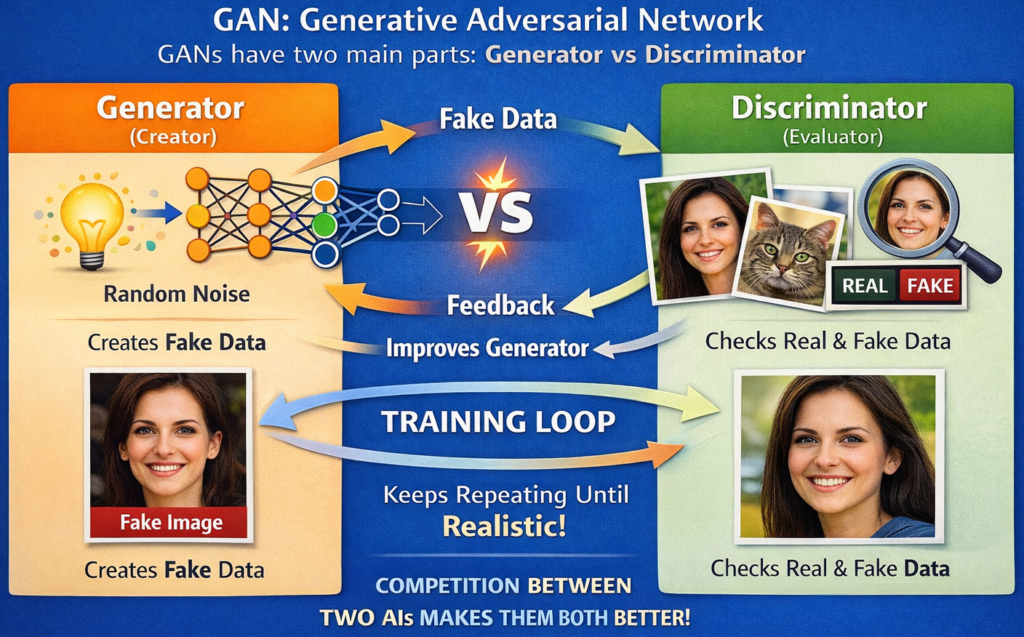
Introduction to Generative AI and GANs
Generative Adversarial Networks (GANs) are one of the most exciting ideas in generative AI. They are computer programs that learn to create new data — such as images, music, or text — that look like real examples.
GANs are widely used in fields like image generation, deep learning, computer vision, and artificial intelligence education, making them an important topic for students interested in technology.
GANs were first proposed in 2014 by Ian Goodfellow, and they quickly became a major breakthrough in machine learning.
What is a Generative Adversarial Network?
A Generative Adversarial Network is a type of deep learning model made of two neural networks that compete with each other during training.
The word “adversarial” means they are in a competition, and this competition helps the system learn.
Main Components of GANs
1. Generator (G)
The generator is responsible for creating new data.
Over time, it learns patterns from real data and improves.
It takes random noise as input.
It tries to transform this noise into realistic data.
At the beginning, its outputs are poor.
2. Discriminator (D)
The discriminator evaluates data and decides whether it is real or generated.
It acts like a classifier.
It receives both real examples and fake ones.
It outputs a probability of whether the input is real.
How GAN Training Works
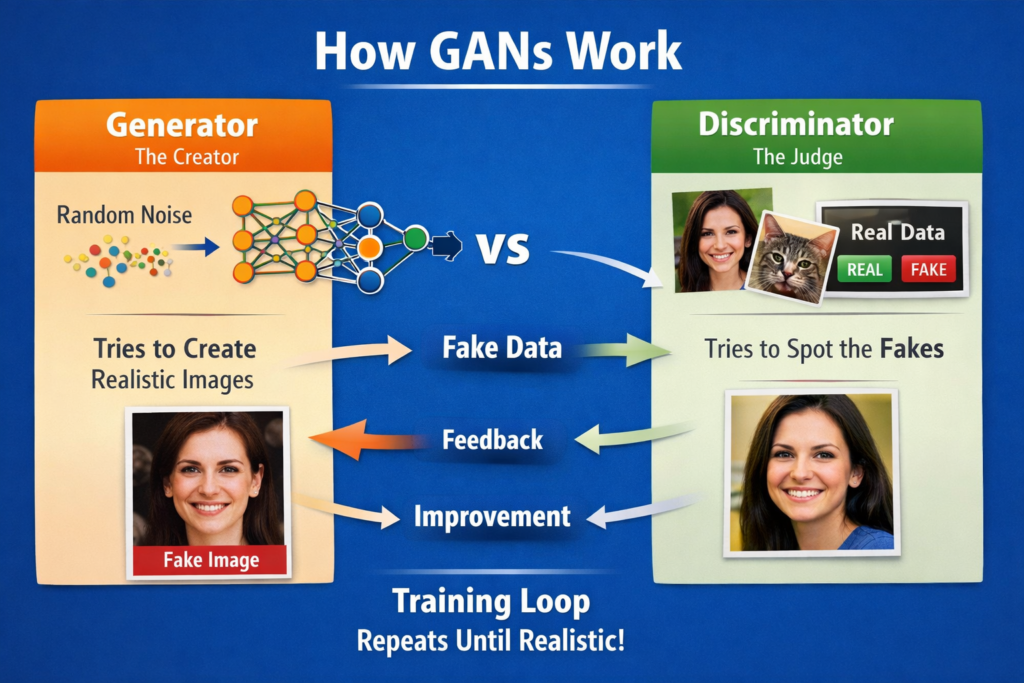
Training a GAN involves a repeated cycle called adversarial training.
Step-by-step process
- Real data is taken from a dataset.
- Random noise is fed into the generator.
- The generator creates fake data.
- The discriminator evaluates both real and fake data.
- The discriminator gives feedback.
- The generator updates its parameters to improve.
- The process repeats thousands of times.
Why GANs Are Important in Artificial Intelligence
GANs are important because they can generate new content, not just analyze data. This makes them useful in many real-world applications.
Applications of GANs
- Image generation (faces, landscapes, art)
- Deepfake technology
- Video game design
- Medical image enhancement
- Super-resolution imaging
- Fashion and product design
- Data augmentation for machine learning
Advantages of GANs
- Produce highly realistic outputs
- Learn complex data patterns
- Work without labeled datasets (unsupervised learning)
- Useful for creativity and simulations
Limitations and Challenges of GANs
- Training instability (models may not converge)
- Mode collapse (generator produces similar outputs)
- Difficult to evaluate quality
- High computational cost
- Ethical concerns such as misuse for fake media
Types of GANs (Overview)
Researchers have created many variations of GANs to improve performance.
- DCGAN (Deep Convolutional GAN) — used for images
- Conditional GAN (cGAN) — generates data based on conditions
- CycleGAN — transforms images from one style to another
- StyleGAN — creates highly realistic faces
GANs vs Other Generative Models
Compared to models like Variational Autoencoders (VAEs), GANs usually produce sharper and more realistic images, but they are harder to train.
Ethical Considerations
Because GANs can create very realistic content, they raise ethical questions:
- Spread of misinformation
- Privacy concerns
- Fake media detection
Researchers are working on responsible AI methods to reduce misuse.
Future of GANs
GAN technology continues to improve and is expected to play a big role in:
- Virtual reality
- Scientific research
- Creative industries
- Personalized digital experiences
As computing power increases, GANs will become even more advanced and accessible.